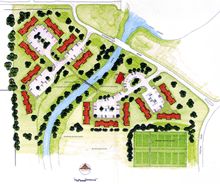
All apartments will have 1,000 square feet of living space, with a
living room, kitchen, two bedrooms and a full bath. The two-story townhouse
units also will feature a half-bath. Each fully furnished unit will
have a washer and dryer; a full kitchen with all appliances, including
a dishwasher and microwave; central air-conditioning; high-speed computer
data ports, and campus cable television.
The project, which is estimated to cost $11 million, is sponsored by
the UB Alumni Association and the UB Foundation Inc. The architect is
Lauer-Manguso Associates. Rents charged for the apartmentsÑwhich will
be comparable to the other apartment-style units on campusÑwill cover
the cost of construction.
The public land on the North Campus was made available for private
housing development due to a clause in state education law that allows
SUNY trustees to work with alumni associations to develop housing on
SUNY campuses.
The Board of Trustees approved the Skinnersville project at its June
19 meeting.
The complex is designed to meet what Clifford B. Wilson, associate
vice president for student affairs, calls a Òhuge demandÓ for housing
for graduate, professional and married students. While other residential
complexes that have been constructed during the latest building boom
have housed some graduate and professional students, only oneÑFlickinger
CourtÑis devoted solely to those students and also offers space for
married students, both graduate and undergraduate.
Wilson notes that there is a waiting list at Flickinger CourtÑlocated
at Chestnut Ridge and Sweet Home roads, adjacent to the North CampusÑas
well as at the other residential complexes on campus.
Joseph Krakowiak, director of residence halls, agrees.
ÒWeÕre under-capacity for undergraduate and graduate apartment spaces,Ó
Krakowiak says. ÒOver the past four years, the culture of choice for
students is changing. More students want the convenience of living on
campus, as opposed to moving off campus.Ó
He points out that many students who moved off campus as UB undergraduates
now are interested in living on campus as graduate students.
ÒThe demand is steady and growing for all types of housing,Ó he says.
Wilson adds that increasing the number of apartment spaces for graduate
students also should help in meeting Provost Elizabeth D. CapaldiÕs
goal of increasing graduate enrollment, particularly at the masterÕs
level.
He notes that the administration has vetted the project with the Environmental
Task Force, and the plans are Òwithin the guidelines set by the EFT
for developing this particular piece of property.Ó For example, he says,
the buildings will be constructed 100 feet from both sides of Bizer
Creek, and a significant number of trees will be spared.
Moreover, the project will adhere to the executive order on energy-efficient
buildings that was issued by Gov. George Pataki on June 10, he says.
The Skinnersville project, slated for completion in August 2002, is
the fifth project in the universityÕs long-term plan to provide housing
for students and improve their quality of life.
The other projects and their completion dates are Flickinger Court,
August 1998; Hadley Village, August 1999; South Lake Village, August
2000, and Flint Village, which is scheduled to open this August.
Wilson also notes that a study on converting Goodyear Hall on the South
Campus into apartments is expected to be completed by mid-September.
And the master planning process to determine uses for the parcel of
land along Lee Road from The Commons to the Ellicott Complex on the
North Campus, which likely will include student residential space, also
is expected to be completed this fall.