| VOLUME 32, NUMBER 3 | THURSDAY, September 7, 2000 |


By Ann Whitcher
After 46 years of teaching at UB, Charles H.V. "Vince" Ebert retired last June. But for this energetic, emeritus professor of physical geography, it is a technical retirement only.
Ebert, 76, is teaching four courses at UB this fall ("almost double the load of my colleagues," he says, mischievously). "I do itŠbecause I enjoy it so much. And then I'll be off in the spring semester and the summer doing writing, research and trying to slow down a little bit, but it's very hard for me." Ebert plans to continue this pattern, at least through the 2002-03 academic year.
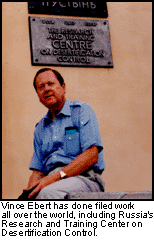
Over his long career, Ebert has done field work in Russia, China, Taiwan, Central and South America and Iceland. He also participated in archaeological excavations in Israel, and was the first UB faculty member to take part in an exchange program with the Jagiellonian University in Krakow, Poland.
Ebert's career spans five UB presidents-from Clifford Furnas to William R. Greiner-and an estimated 30,000 students who have heard him lecture on all things geographic, from acid rain and Love Canal, to world conflicts and asteroids.
He joined the UB faculty in 1954 and became the founding chair of geography following the 1962 merger with SUNY. While serving as dean of undergraduate education from 1970-77, he continued to teach full time. He published numerous articles on soil problems, land development and environmental hazards. But teaching was always his top priority, and in 1989, he was named a SUNY Distinguished Teaching Professor, in addition to having received five awards for the quality of his teaching.
Born in Hamburg, Germany, to American parents, Ebert spent most of his youth in Switzerland. His father, an export manager for a New York firm, would invite his young son on trips abroad as a reward for good schoolwork. Ebert was considering a career as a globetrotting journalist and photographer when World War II, "a major break" in his life, intervened. He served four years in the U.S. Army before pursuing his bachelor's, master's and doctoral degrees at the University of North Carolina at Chapel Hill.
"I was first interested in political science and languages, but I immediately dropped out of that program because it did not satisfy my interest in science," he says. "Then I concentrated in geology and soil science and physical geography. I think that geography, particularly in the past, represented a link between the physical world and humanity. Being strictly a geologist did not satisfy my curiosity about people. On the other hand, being a social scientist would not have satisfied my interest in hard science."
When Ebert teaches, he brings to the fore his travels and scientific investigations, along with his formidable language skills-he speaks French, Russian and Spanish in addition to German.
"I enjoy languages. And I think my students always get a big kick out of it when I use a word, and then explain what it really means," he says.
"I think the secret of good teaching is to be human, so that the students see as you a human being of interest to them."
Once, while teaching a section of his long-running and popular undergraduate course on "Disasters" (subject also of a fourth edition of his textbook issued last month under the new title, Disasters: An Analysis of Natural and Human-Induced Hazards), Ebert spoke of the impact of war-its inherent destructive power, and how monstrous actions are often viewed one-sidedly. "I talked about the firestorm in Hamburg, Germany, on July 27, 1943, in which more than 50,000 people were killed in a few hours. Then I stopped for a few minutes, and said, 'Let's look at the other side of the coin-the Bataan Death March of April 1942 when the Japanese killed thousands of American and Filipino prisoners of war. Or look at the Holocaust and (think about) what the Nazis did.'"
At this point, Ebert recalls, he was overcome with emotion and had to halt the lecture before 400 students in Knox Hall. "All of a sudden, several students came up and hugged me. It was an incredible experience, and it had nothing to do with the rewards of teaching, it had to do with sharing a human emotion.
"Over many years of teaching, there were many highlights, many moments of tension," he says, "but more good moments than bad ones. They were all part of the story."
After 46 years of service to UB, Charles H.V. Ebert enters a new phase of his career

Reporter Contributor
 "Time off" for the peripatetic professor means activities like climbing Sicily's Mt. Etna, which he did last May, or researching a major article correlating the Biblical story of the parting of the Red Sea to natural events in the ancient world, perhaps the gigantic seismic sea waves that flooded the Nile delta more than 3,000 years ago. And it means continued worldwide travels with his wife, Ilse, and more visits to Baltimore to see the couple's daughter, Monica, and grandson, Kyle.
Front Page | Top Stories | Photos | Briefly | Q&A
Electronic Highways | Sports | Events | Current Issue | Comments?
Archives | Search | UB Home | UB News Services | UB Today