Visitors to the latest exhibit originating from UB's Art Gallery will have to check their preconceptions of art at the door-along with heavy baggage and disagreeable footwear, either of which could impede riding a bicycle. To begin with, the art housed within the gallery is on the floor-not the walls. The bulk of what there is to see isn't in the gallery, but outside of it-all around campus, in fact. And in order to view this exhibit, you'll be needing a bicycle.
Not to worry-they'll provide one for you at the gallery.
PED-going on now through June 29 in the Center for the Arts-is an interactive installation exploring spatial and social issues created by UB assistant art professors Millie Chen, Andrew Johnson and Paul Vanouse. A seeming play on the words "pedestrian," "pedal" and "pedagogy"-but better left open to interpretation, say its collaborators-the exhibit explodes the framework of art as a painted landscape, hanging on a wall and separate from the viewer, with the viewer, instead, becoming immersed in a landscape he or she can physically negotiate.
On a bicycle, that is.
| |
 |
|
Assistant art professors Millie Chen, left, Paul Vanouse, Center, and Andrew Johnson have taken the concept of “art” off the walls of the gallery. |
| |
photo: Stephanie Hamberger |
"Bicycles, like education, have changed over time," said Vanouse, noting that recreational bicycle-riding once represented privilege of the wealthier classes-as did education. "We're playing around with popular access."
PED-a manifestation of activist, Populist and utopian principles all at once-sets the exhibit-goer out on one of 10 marked trails throughout the North Campus, a ride accompanied by a taped lecture that explores, among other issues, the environment, suburban ideals, urban decay, corporeality, diversity and accessibility.
Johnson says suburban development-and its repercussions-is a recurring theme in the exhibit, which, Chen adds, attempts to throw a wrench into expectations of the educational institution situated within that development.
"We're in a situation where research is key ... (and) taking risks is officially mandated," she said. "We're taking it to task and figuring out the true parameters."
For students, the exhibit encourages a re-thinking not only of art, but the campus space they inhabit, and the larger community as well.
"It's about questioning everything and upping the ante," she said, explaining that PED examines the privileging of suburbia over the city, and the investment in the suburbs while the city continues to drain. The relationship between the two, she said, is symbiotic.
"Nothing is isolated," she said. Culture, urban planning, neighborhoods-the general health of the community, she said-all are affected by the city-suburb flux. "A lot of this is critiquing the suburb-city dysfunction."
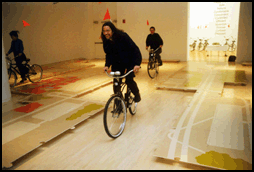
Provided in the gallery, the bicycles can be taken for a test drive around several large puzzle pieces depicting a map of UB set upon the floor before heading out onto one of the mapped trails. The bicycles are equipped with a cassette player and speakers, the audio for which is powered by the rider's pedaling.
"We tried to create an interesting rhythm-an audio journey," Chen said of the construction of the lectures, which range between five and 20 minutes in length. Snippets from historic documents, town meetings, newspaper articles, books on urban planning, music and the like are included in the lectures, narrated by a predominant "character." From blurbs by William Shakespeare and Buffalo Mayor Anthony Masiello to words of university representatives, it's an amalgam of fact and opinion, poetry and prose, salesmanship and statesmanship.
"The further you stray (in distance), the further out you get in the psychological," explained Vanouse, adding that various overlaps in the lectures can alter, or enhance, interpretation.
"We're trying to focus on the viewer themselves as an agent of change. We're trying to take advantage of the uniqueness of the situation," Johnson said, noting that rather than students viewing an exhibit all at once, their approach gives way to multiple explorations, with each trail adding a new layer of dimension and understanding.
Chen said the exhibit-like the trio's educational practices-blurs boundaries between art and everyday life, art and social and political issues, and art and the pedagogical institution.
"We're trying to get a rise out of the audience," Chen said. "We tried to approach these lectures not in a didactic way, (but) in terms of opening it up for discussion."
While each of the trails boasts an accompanying lecture, the tone and identity of the speakers varies across the board, with each promoting a "pitch of persuasion" relative to the trail, Chen said. Consider the choices: safe, natural, comfortable, convenient, controlled, efficient, spacious, diverse, civilized, pleasant.
"A lot of this is tongue-in-cheek," Johnson said. "Much of the lectures you're meant to question-not to take at face value," he said, noting that the exhibit is intended to "sensitize students to the issues behind their education."
Among the collaborators' expectations is that PED will loosen from students and members of the UB community the notion that art is contained strictly within the institution, as well as help students explore the possibilities of community beyond the North Campus.
"The fact that some of my students don't realize that this isn't Buffalo" is troubling, Chen said, and PED looks to explore suburbia in the context of urban decline.
"We're trying to uncover the reasons behind the city's demise," Vanouse said. "I don't think it's just us."
For students, as well, crossing borders within campus limits is an integral part of the journey. The exhibit attempts to frustrate inadvertent boundaries set by students and others who traverse UB's terrain-some literally may walk the straight and narrow without diverging from their intended course.
"Unless you have a definite purpose, you may never see some areas of campus," Johnson said.
PED, which offers up not only an informational experience, but a sensual one, is unlike some conventional art that may intimidate those who fear themselves, well, too pedestrian to understand.
"It gets other students from other disciplines to take notice," Johnson said. "You don't need prior training."
Chen said she hopes the exhibit will draw those folks who normally wouldn't visit a gallery.
"Its sole purpose is not for decorative embellishment," she said of contemporary art in general. And PED clearly shows how art can defy conventional wisdom with its form-and function.
An opening reception for the exhibit will be held from 5 to 7 p.m. tomorrow in the gallery. Gallery hours are 10:30 a.m. to 8 p.m. Wednesday through Saturday, and from noon to 5 p.m. Sunday.
Walking-tour arrangements will be made for those who are unable to ride the bicycles provided.


