A century ago, the City of Buffalo opened for the world the gates to its "Rainbow City"-a sweeping spectacle of color and light that defined the Pan-American Exposition of 1901.
Then the eighth-largest city in the nation, Buffalo brought to fruition an elaborate display of architecture and electricity celebrating the economic and technological prosperity of the time-to which millions came to marvel.
| |
 |
|
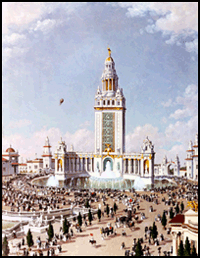
A new book by Kerry Grant looks at the fun and spectacle of the 1901 Pan-American Exposition in Buffalo. |
| |
photo: courtesy of Grace Meibohm |
One hundred years later-and once again illuminating Buffalo-a UB administrator has recaptured the vibrancy and innovation of the Pan-Am in his book, "The Rainbow City: Celebrating Light, Color and Architecture at the Pan-American Exposition, Buffalo 1901."
In keeping with the spirit of community that launched the Pan-American Exposition, the book itself evolved into a collaborative community project. Authored by Kerry Grant, vice provost for academic affairs and dean of the Graduate School, the book was designed by David Buck of Crowley-Webb and Associates, a Buffalo advertising agency. William H. Siener, director of the Buffalo and Erie County Historical Society, provides the introduction to the book, which was printed by Dual Printing and published by Canisius College Press, with financial support from the John R. Oishei Foundation.
After arriving in Buffalo in 1991 as dean of the then-Faculty of Arts and Letters, Grant said he chose to spend time learning what made the community unique. In doing so, he became aware, through a colleague, of the most significant moments in Western New York history: the Pan-American Exposition.
Grant, a Pan-Am enthusiast and collector of exposition artifacts since acquainting himself with Buffalo's history, said what intrigued him most about the Pan-Am was its extraordinary use of color throughout the exposition grounds. But the images Grant came across of the Pan-Am most commonly were black and white photographs. He began to gather materials that addressed the use of color-such as guidebooks, periodicals, lithographs and maps-as well as provided clues to what he considered to be an incredibly well-executed treatment of architecture, landscaping, color and art.
Grant proposed to Siener that a volume celebrating the artistic accomplishments of the Pan-American exposition would be a fitting centennial project. Joseph F. Bieron of Canisius College Press, himself a Pan-Am enthusiast, soon came into the fold, as did Buck, who was chosen as the book's designer not only for his award-winning credentials, but also for his shared interest in the exposition.
The book-a rich textual and visual tapestry, 160 pages in length-brings to light the ambitious color and architectural schemes that symbolically depicted and celebrated the progress of civilization. A "coffee table"-style publication, the book draws on images and artifacts from private collections, as well as the historical society. Paintings by artist John Ross Key-which recently were restored in anticipation of the centennial-are featured throughout the book. And architectural renderings and works that never before have been displayed or published-including original promotional pieces for the Pan Am, advertisements and paraphernalia-also contribute to the book's 200-plus images.
The Pan-Am has been of unwavering interest to Grant, who sees the event as "a very important cultural landmark."
Spanning some 350 acres, the Free Renaissance-style buildings of the Pan-Am were designed to be temporary, constructed of plaster and fiber binder-a material like stucco-that could be torn down easily when the exposition closed six months later.
Buffalo's Rainbow City by day was a flood of red, blue, green and gold hues, and at night, the buildings were transformed into the "City of Living Lights." At the center of this spectacle was the Electric Tower, a symbolic beacon of technological prowess for the time, as well as an aesthetic triumph that loomed more than 400 feet above the grounds of the exposition.
The exposition grounds merged into Delaware Park, offering as its entrance the natural environs of the park. One even could travel by gondola to the exposition by way of the lake, Grant noted, infusing the event with a charming romanticism.
"A lot of what Pan-Am was, was the fun and spectacle of it," he says. But the book delves deeper, touching not only on the involvement of technology and architecture in the exposition, but also the involvement-and exclusion-of women and people of color.
"Women's rights and race-these issues were clearly important at that time for what was going on with both groups," says Grant.
The book's formal release April 25 will be marked with a public reception and book signing from 5:30-7:30 p.m. in the Buffalo and Erie County Historical Society, located at the corner of Elmwood Avenue and Nottingham Terrace in Buffalo.


