The sabbatical leave may be one of the most misunderstood aspects of academe to those outside the academic environment.
But far from being the vacation that many cynics believe, sabbaticals can prove to be even more rigorous-and fulfilling-for scholars than life on campus.
Just ask longtime faculty members Claude Welch and Jeannette Ludwig.
Welch, SUNY Distinguished Service Professor in the Department of Political Science, and Ludwig, associate professor of French in the Department of Modern Languages and Literatures, are in the midst of a whirlwind sabbatical in Europe and Asia that would tax a graduate student half their ages.
| |
 |
| |
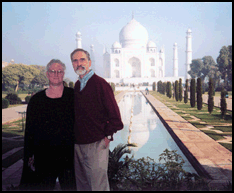
Faculty members Jeannette Ludwig and Claude Welch are proof that sabbaticals can be even more rigorous—and fulfilling—for scholars than life on campus. |
| |
Photo: Claude Welch |
The husband-and-wife team of scholars says the sabbatical enriches their teaching and research, as well as their personal development, while providing valuable, uninterrupted time for writing.
In a protracted interview conducted with the Reporter via email from various locations abroad, Welch and Ludwig provided the details-to-date of their year-long leave, which started early last June in Geneva, Switzerland.
Geneva-the locus of much U.N. human-rights activity-was the ideal spot for Welch to begin work on a new book manuscript that examines the effectiveness of human-rights organizations like Amnesty International and Anti-Slavery International. The book, he noted, is a follow-up to one he wrote on human-rights non-governmental organizations (NGOs) in sub-Saharan Africa while on his last sabbatical in 1993-94.
Ludwig worked on developing material for two new courses, reading what Welch called "some of the most challenging works either of us has seen" and doing groundwork for several scholarly papers.
While in Geneva, they flew twice to England-once for a week in London, during which Welch interviewed officers and examined records of Amnesty International and Anti-Slavery International, and once to Oxford, where he gave a seminar, consulted more anti-slavery archives and interviewed persons from Oxfam, another organization he intends to examine in his book.
Ludwig returned to the U.S. in July to spend two weeks at Brown University, where she served as a faculty-development specialist for "Boundaries and Borderlands," a seminar sponsored by the American Association of Colleges and Universities and focused on the issues of teaching American pluralism.
Also in July, Welch spent three weeks in Botswana as a visiting faculty member for the African Center for Security Studies' senior leadership seminar.
"We expect several visitors in the spring, but thus far it's been quiet for us," Welch wrote before the semester break. "Not that we have much space: Our 'duplex' apartment isn't much larger than our living room (in Snyder).The location is great, for the village of Ferney-Voltaire is convenient to the U.N. part of Geneva and has all the services one can want within easy walking distance. Nothing better than fresh croissants in the morning! We do need more space, however," he continued, "for it's hard to have two 'Type A' personalities with major projects to complete contending for the same four square feet of desk area.
"I spend most days in the libraries of the United Nations or the World Council of Churches-that is, when there are no important human-rights meetings I should attend," he wrote.
"We both read the Geneva newspapers closely, picking up lots of colloquial expressions along the way. Without question, our linguistic proficiencies have has been remarkably enhanced."
The pair left Geneva at the end of November to spend four weeks in India-the birthplace of Hinduism, Buddhism and Sikhism-where visits to sacred sites provided source material for the courses they teach on comparative religions and World Civilization, respectively.
Welch, working under a U.S. Institute for Peace research grant, pointed out that few of the regular corps of teachers of World Civ at UB have carried out extensive research on teaching about India, "despite its size, diversity and importance in global history. I wanted to help fill this lacuna," he said.
Ludwig said she found that the time spent in India-a departure from the "linguistic-based reading and writing that is occupying the bulk of the sabbatical year"-strengthened her understanding of religious practice in the subcontinent and will contribute "immeasurably" to her teaching.
"First, being present and observing people's activity at individual loci sancti that draw pilgrims from all over the world teaches 'the face of faith.'" she wrote. "There is no substitute for circumambulating the great 'pool of nectar' at Amritsar with Sikhs, chanting the Heart Sutra before the Mahabodi monument at Bodhgaya with Buddhists, or witnessing the daily bathing and cremation rituals at the ghats of Varanasi.
"The second and doubtless most important aspect of the venture," she continued, "was ongoing and spontaneous conversations with everyday practitioners-from university faculty to shopkeepers and those who pedal rickshaws, to a Brahmin priest and head of a temple who was simultaneously a professor of civil engineering concerned with water quality in the Ganges.
"It was an unparalleled opportunity to talk directly with people about how they make choices about their faith, what specific practices they engage in and how they raise children in a world that sometimes makes religion difficult," Ludwig said.
She maintained that the time spent in India afforded her a better grasp of how the country deals-personally, politically and publicly-with its own issues of religious pluralism.
In addition to gathering material and experiences that would prove useful in his teaching, Welch delved into the human-rights struggle of the "Dalits," the subject of one chapter of his book. The term now is used to describe the group widely known as the "Untouchables."
While in the coutnry, he also lectured at a variety of venues, among them several universities, the Rotary Club of Baroda and a national human-rights conference.
"These contacts with scholars and human-rights activists turned out to be extremely important in building bridges of trust and understanding," he said.
The pair for the time being is based in the Netherlands, where Welch is serving as visiting scholar at the School of Human Rights Research at the University of Utrecht. He also plans to deliver invited lectures in Germany and Austria.
Welch noted there are countless benefits to faculty members-as well as the university-when scholars take sabbatical leaves.
"It is the only way in which I could carry out the necessary extensive field research that a book of this sort requires," he wrote. "It could not be written without direct contact with NGO leaders, who need to be spoken with 'on the spot.'
"It is also possible, through a sabbatical, to take time for the concentrated writing," he said, pointing out that he sets for himself a regime in which he does not allow himself lunch until he has fulfilled a quota of written words. "Not that my practice is perfect," Welch noted, "for the rhythm of writing a book goes through cycles, when concentrated research is essential, rather than combined research and writing."
And then, there are the bookstores. Shops in New Delhi, in particular, provided a wealth of tomes not yet-or not easily-available in the U.S., especially in the areas of caste, women and socio-religious practice.
"We're filling our already bursting suitcases," Welch joked.


