The melodies are eerie and arcane but immediately engaging-a tiny marimba band ebbs and flows to the throb of a beating drum. Syncopated footfall melds into the high-pitched crack of stick on stick, stone on stone.
In fact, these multi-tonal crystalline songs are being tapped out on
flint tools-spear heads, blades and burins-virtually identical to cutting,
gouging and incising instruments carved by people living 30,000-40,000
years ago during the Upper Paleolithic era.
The production of proto-Paleolithic tools and their analysis as possible musical instruments are part of a multi-year project by UB, Cambridge University, the Cincinnati Museum Center and the British Academy designed to study the relationship between music and cognition.
| |
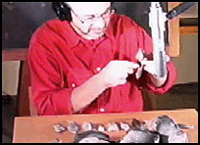 |
| Prototypes of Paleolithic flint tools are being used by researchers to study the relationship between music and cognition.e |
| |
The specific project aim is to determine if music is the catalyst that separated Homo sapiens sapiens from Homo sapiens Neanderthalensis-Neaderthal man.
Ezra Zubrow, professor of anthropology, is one the project's principle investigators, along with Ian Cross, lecturer in music at Cambridge, and Frank Cowan, curator of the Cincinnati Museum Center.
They determined that the relationship between the origins of music and the origins of cognition could be clarified if it could be determined that music caused hominid evolutionary change or, conversely, that human evolutionary change produced music.
The question of music's role as an evolutionary determinant is not a trivial
one, Zubrow says. He points out that one of the prevailing views of
humankind is that we are essentially "wild, Hobbesian, warfare-loving
animals who came slowly and relatively recently to civilization."
If music can be proven to have existed as a cultural trait from the Paleolithic era, then it is likely, Zubrow says, that the species we call Homo sapiens sapiens-anatomically modern humans-was, even in its first days, actually a relatively civilized, social and artistic group. This contradicts widely held suppositions that violent, aggressive behavior is mankind's "natural" state.
Although using stones to produce music may seem an odd idea to many of us, such instruments are common to many cultures. Zubrow cites African and Peruvian stone bells and the pian ch'ng, or Chinese stone gong, as but a few examples of traditional ancient stone musical instruments.
"In more recent times, we have the 'geological piano' of Victorian vintage," he says. "It was a lithophone produced by replacing piano strings with tuned stones that then were struck by the hammers. Contemporary musicians, particularly percussionists, have played music on stones or rock, and composers have written music specifically to be played on stones. There is a stone percussion section of Karl Orff's opera 'Carmina Burana,' for instance."
So far, the earliest suspected musical instrument is a Neanderthal flute dating to 43,000 years ago that was found in Slovenia. It is a very controversial find, however. The earliest item generally agreed to be a musical instrument is a 36,000 year-old bone pipe found near Wurtemberg, Germany.
"We suspect that music was made much earlier than that," Zubrow says, "but if the instruments used were, like the pipe, made of organic material, they would have disintegrated quickly. So we weren't likely to prove our hypothesis by searching for Paleolithic instruments of bone, horn, skin, ivory, antler or wood."
The team postulated that Paleolithic people might have manipulated other items to produce music-their stone tools, for instance. To test this hypothesis, the team designed an experiment.
With the help of Cowan, an expert flintknapper, the researchers produced 200 experimental prototypes of Paleolithic flint tools using Upper Paleolithic technology, i.e., stone chipping. Each blade, core and flake (specimen) was classified, measured and its composition characterized for historical and geologic accuracy.
Next, the team set out to determine if the prototypical blades could be used to produce music. Music students from Cambridge were enlisted to "play" the blades to determine if, by percussion or any other kind of action, they could produce what they and the team would consider to be musical sounds.
The blades were played, analyzed and recorded during three periods: a practice period (120 percussions struck), an initial period (600 percussions) and a performance period (600 percussions) using acoustic equipment and analysis software.
Each blade was photographed and measured before and after play using binocular microscopes and material-analysis software.
Part one of the study produced the following conclusions:
- Upper Paleolithic blades are similar in shape and acoustic properties to marimba bars. If struck correctly, they produce an acoustically pure sound.
- Different nodes on the stone blades produce different notes when struck and that blades can be "tuned" by chipping.
- When "played," the stones produced music that was not only rhythmic and multi-tonal, but also quite mellifluous. An audiotape of the results indicates that at least in contemporary terms, the sounds produced are "musical." Researchers added the rhythmic beating of a wooden "drum" of a type that might have been used during the Upper Paleolithic period. (The audiotape can be heard at http://www.buffalo.edu/scripts/newnews/index.cgi?article=research13.)
- Although it is impossible at this point to prove that Upper Paleolithic man did produce music, he could have done so by striking his stone blades, gouging tools, spear heads and other items in a rhythmic pattern.
- The process of "playing" the stones produced on each of them a distinctive pattern of strike marks that experts say cannot be made in any way other than repeated, even rhythmic striking.
- Players' different playing styles that can be determined both aurally and by examination of the unique wear patterns that their playing produced on the stones.
If Paleolithic people did play their tools, the researchers knew that the unique strike patterns produced on experimental tools should be visible on the original stone items upon microscopic examination.
To that end, the researchers examined hundreds of flint tools in the Cambridge University Museum of Archaeology and Anthropology that date from the Paleolithic period.
They found that while most did not bear the strike marks found on the experimental tools, a few from the famous French site at Cro Magnon did present them.
"This concurs with expert opinion that strike marks or surface coning produced by 'playing' the tools does not occur through normal use of the tool," Zubrow says. "It indicates that even if some Paleolithic stone tools were used to produce music, not all were used for such a purpose."
"The Cambridge sample is very small, however," Zubrow says. "Our next step is to code and analyze use-wear patterns on thousands of specimens of flint tools excavated from major European Paleolithic sites. "Again, we'll be looking for strike marks like those produced from rhythmic play."
"This is a huge job," he says, "but upon its completion, we may be able to draw conclusions about the origins of human musicality and its temporal relationship to the development of human cognition."


