Lisa Stephens doesn't strike you as the type who's frazzled easily. A former technical director for ABC-TV in Chicago, Stephens-now associate director for distance-learning operations at UB-is well-versed in pressure situations of an immediate nature, and understands the kind of behind-the-scenes mentality needed to stay out of the fray while keeping operations as seamless as possible.
"I've never had that happen before," Stephens says, smiling about a glitch in setting up for the Library and Information Studies class that was to begin in less than 15 minutes in 200 Baldy Hall-one of three distance-learning classrooms at UB and a premiere classroom in New York State.
Operations run smoothly in this mass conglomeration of technology that Stephens built with engineering colleagues a few years ago, for this Monday afternoon class as well as all others. Overall, she says, "we haven't had many breakdowns."
| |
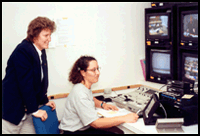 |
| Lisa Stephens (left), associate director of distance learning operations, watches as MFC graduate assistant Mercedes Joshi mans the controls of the distance-learning classroom in 200 Baldy Hall. |
photo: Stephanie Hamberger |
| |
Employed for nearly a decade at ABC, Stephens was baptized by fire into the frenetic media, working on live production in the nation's most competitive news market, as well as on shows such as "The Oprah Winfrey Show," "Good Morning America" and "Nightline."
It's no wonder, then, that she's composed at the first signs of a flare-up. "Sometimes it's like that," she says of the short burst of chaos that had ensued just a few minutes earlier. "That's why we set up a little early-to avoid losing any instructional time." She's in her office down the hall, while one of her graduate assistants produces the class from the control room. Managing 17 classes this semester along with Instructional Technology Specialist Beth Fellendorf, the only other full-time staff member supporting North Campus operations, Stephens is responsible for nearly 850 hours of classroom time-roughly 74 hours per week. This includes overseeing distance-learning interactive video operations, as well as providing training and instructional support for faculty and staff members, and those who occasionally contract from outside the university. Stephens says 27 distance-learning classes are slated for next semester, including those held in distance-learning classrooms in Abbott Hall on the South Campus and in Bell Hall on the North Campus through the School of Engineering and Applied Sciences.
"The demand has been growing at an incredible pace," she says, noting that in fall 1999, classes and special events-such as hosting a guest speaker via live video-totaled about 46 hours weekly; next semester, that number will more than double and come close to maximizing the capacity of the Baldy classroom.
Integrating technology shouldn't throw off the instructional balance, Stephens says, and her aim is to make technology "as transparent as possible."
"Faculty are here to teach-we take care of the distance-learning connections for them," she explains. "We try to minimize any distractions imposed by the technology on faculty and students."
Distance learning is nothing new to the university, nor to Stephens, who joined UB in 1996 as an instructional support specialist in the School of Engineering and Applied Science's distance-learning network, EngiNet.
"A lot of people don't realize that SEAS faculty were on the cutting edge of distance learning more than 25 years ago on a system called GEMS-NET," she says.
"
University interest was growing," says Stephens, who earned a master's degree in television, radio and film from Syracuse University's S.I. Newhouse School of Public Communications before working as assistant executive director of Lockport Community Television and serving as an adjunct instructor at Niagara University. Wanting to expand distance learning's focus to a wider academic community, UB in 1997 charged Millard Fillmore College with developing UB's distance-learning program. Stephens came on board in 1998.
"We have considerable expertise with distance learning at Millard Fillmore College to help departments," she says, explaining the facilities and services are multi-modality. The video operation is only part of the MFC Distance Learning Team effort; the online learning operation is based in Parker Hall on the South Campus. "We can reach students on a local, regional or global level through videotape, computer networks, a high-quality Western New York regional fiber-optic network, or through digital telephone systems.
"(UB) can go anywhere in the world" with use of ISDN-or Integrated Systems Digital Network-lines, she says as she works on securing a connection with a site in Manitoba. A student in the Department of Social and Preventive Medicine is scheduled to begin a video interview with a prospective employer in the Canadian province momentarily.
"UB truly is 'breaking ground'" with its use of new technology that allows
high-quality videoconferencing over Internet 2, a non-public, high-speed
network shared by universities, she says.
Internet 2 is a cost-effective way to communicate, versus using ISDN, which nets a recurring long-distance charge, she says.
"With the Internet, you don't have the costs, but the quality is not quite as predictable-it's an emerging technology that many professors are willing to try," she adds.
The best quality transmission for interactive video classes is found on the Western New York Distance Learning fiber-optic system that's available in elementary and secondary schools, as well as BOCES centers. But it's limited to regional sites connected only through Verizon.
"It's a great solution for students who want to attend UB classes but can't get out of work fast enough to make it to late-afternoon classes," she says. "We've received a lot of high marks from students, particularly in the Department of Library and Information Studies and the Graduate School of Education.
"Library students from the Rochester area are thrilled they can receive their classes in Batavia," she says, "and we hope to secure a site in Rochester that will attract students further east of the area."
For the Monday class, UB was connected to a site in Elmira using ISDN and one at Frewsburg Central School via the fiber network. The session begins with a guest lecturer from Niagara University, who seems perhaps a bit unnerved by the profusion of televisions and equipment surrounding him.
"So much depends on the character of the faculty and the character of the students," Stephens says, noting that most get used to the style of teaching required for that environment. But with interactive video, you can't simply expect human nature to cue in naturally. Nuances-many of them not so obvious to the first-time user-can affect dramatically the classroom dynamic. For example, Stephens encourages instructors to look into the mounted video camera-not the monitor-if true eye contact is to be made with students at remote sites.
"Some strategies for gaining and keeping student attention at a remote site can be borrowed from teaching in lecture halls, looking into the camera and calling on a student by name is very helpful. I think there's a fundamental difference in how a remotely situated student feels 'individual' as a result."
Stephens-originally from Wilson and now re-settled in the area with her husband-is enjoying herself, even "during days where the pace is just unreal."
"I really enjoy working with my distance-learning colleagues, the faculty and the students at this university-there's never a dull moment.
"A lot of our success is the result of some creative collaboration with folks both on and off campus," says Stephens, who also is a student at UB. She's begun work on her dissertation and hopes to complete her doctorate in higher education administration next spring. She says UB's "growing pains" regarding technology are similar almost everywhere.
"I had a wonderful opportunity to talk with faculty at an international conference in Taiwan this past summer. It's always reassuring to find out that we're not alone in the challenges and rewards that distance learning presents.
"We're poised to expand programs, but are faced with limited resources-what is a particular piece of equipment's useful life? Can we effectively support it? It makes for a delicate balance where expansion is concerned," she says.
Even if the technology kinks aren't completely ironed out, the human learning curve certainly is improving.
"We're getting very good at this," she said. "We're getting very efficient."
The students also are much less tentative with technology.
"It makes all the effort worth it when I see students carrying on a conversation as if there were no distance between them," Stephens says. "It's fun to see those relationships develop."


