In their most harried moments, faculty members trying to balance the demands of teaching, research and family sometimes may feel that the only solution to their overloaded schedules is to be in two places at once.
And now-for better or worse-they can.
| |
 |
| |
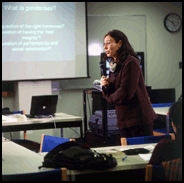
Bernadette
Wegenstein teaches “Bodyworks” in real-time with a Stanford colleague
using pioneering technology developed at UB. |
| |
photo:
Frank Miller
|
Advances in Internet videoconferencing pioneered, in part, at UB have
made it possible for two faculty members to teach semester-long courses
in classrooms separated by thousands of miles; they also have permitted
a third faculty member in the School of Medicine and Biomedical Sciences
to treat patients in rural areas remotely, using an inexpensive, wireless
hookup.
Each of these experiences was showcased Tuesday during Megaconference II http://www.mega-net.net/megaconference/, billed as "the world's first totally online conference on the use of teleconferencing in research and education."
"This is the future coming at us," declares James Whitlock, associate director of computing services and a key player in UB's Internet videoconferencing efforts.
Three of the conference's 13 presentations featured UB faculty members as lead presenters or major participants.
While many large universities and institutions have attempted videoconferencing
over Internet 2 for special, one-time events, UB is one of a handful
in the world that has succeeded in using it for regularly scheduled
classes, a fact that served the institution well during the Megaconference.
"The quality of the video and audio coming from Buffalo was the best I saw in our rehearsals," says Arif Khan, network engineer for OARnet Network Operations, which coordinated the conference.
Adds Lisa Stephens, associate director for distance learning operations in UB's Millard Fillmore College: "We have proven that UB can accommodate classes reliably through Internet 2. We know it works and we know it saves money; now it's a question of who can we reach where."
UB's experience with Internet videoconferencing began years ago when a group of individuals in Computing and Information Technology, led by Whitlock, began to see how it could make the technology work for UB.
The presentations at Megacon-ference were the result of the expertise garnered by the UB technical staff, combined with the real-world needs of the university's faculty members.
"Bodyworks"
Perhaps no one had a better reason to embrace this new technology than Bernadette Wegenstein, visiting professor of comparative literature. As a visiting scholar at Stanford University, she had planned to co-teach with Timothy Lenoir, a professor of the history of science at Stanford, a groundbreaking course entitled "Bodyworks" that Lenoir had developed about how technology has altered perceptions of the human body.
But last fall, just as Wegenstein was anticipating the birth of her first child, her husband, William Egginton, also a humanities professor, accepted a position in the Department of Modern Languages and Literatures. Wegenstein wondered if there was a way she could still co-teach the course in the spring semester from Buffalo using the Web.
She approached staff members at Millard Fillmore College, who made contact with their Stanford counterparts.
At first, no one was thinking about using Internet 2.
"When we first started talking with Stanford, the plan was to use the regular Internet with a video link," recalls Stephens. "That gives you a connection, but the images are pretty choppy and low-quality. Then while we were talking about it, one of the people at Stanford said: 'You know, I've been trying to work on this H.323 stuff' and I just burst out laughing. I told them they had just fallen into a hotbed of people working on this stuff.'"
According to Stephens, Whitlock and his colleagues had been experimenting with this technology for years before other institutions became interested.
"Had we not been positioned by Jim's earlier efforts, we could not have taken advantage of this technology for 'Bodyworks'," Stephens explains. "We just bruised our knuckles on this before a lot of other people did."
In addition to the live, interactive nature of the classes, Internet videoconferencing for distance learning at UB also involves extensive online discussion groups, Web-based resources and curriculum materials and digitized video clips.
For "Bodyworks," in particular, there was an extensive amount of such material.
But the biggest hurdle remained connecting the two classes and keeping them connected through the semester.
The technical staffs at the two universities started working together immediately to make the course a reality.
"What made this so exciting was that it was bicoastal," says Stephens, "and the quality of the connection allowed students and instructors to engage in spontaneous conversation. The bandwidth available on Internet 2 is what makes this possible."
Despite the fact that such a grand experiment was in a lot of ways just that-an experiment-the two universities pulled it off. While new technical difficulties frequently surfaced, they only caused one cancellation of the class.
"Bodyworks" was an especially interesting course to do this way, Wegenstein notes.
"The presence of the medium that we were actually analyzing benefited the students," she explains, "because we were looking at issues of reality and virtuality."
In addition to the kind of almost awe-inspiring sense of connection students in the two classes felt, Wegenstein points out that the experience allowed them to come to a new way of understanding the Web and its possibilities.
"There was a kind of concretization of the Internet itself," she notes. "Usually Internet experiences are ones you have while you are sitting by yourself at your computer. But here, it suddenly became a social medium."
"Turbulence"
At about the same time that UB and Stanford were working together to prepare for "Bodyworks," William K. George, former professor of mechanical and aerospace engineering, was trying to figure out how to participate in a National Science Foundation program at the Institute for Theoretical Physics at the University of California-Santa Barbara while continuing to teach his graduate course on turbulence at UB.
The result was a cooperative effort with faculty members from five institutions-including UB and UCSB-participating. For two hours each week, George lectured live to students from the participating universities; other faculty members and guest lecturers researching turbulence at the Institute of Theoretical Physics also participated.
According to the students, the guest interviews, which never would have been part of a regular course, were the highlight.
In a paper about the course that was delivered at the International Conference of Engineering Education in Taiwan in August, the UB instructors and technical staff noted: "The students received an exposure to ideas far beyond the scope of a normal course. Many of the top researchers in the area are now familiar faces to them. This both inspired them and should facilitate their entry into the technical arena."
Telemedicine applications
While UB's early interest in Internet videoconferencing allowed the institution to find solutions to the purely logistical difficulties of some individual faculty members, it also has allowed UB to support efforts of others to determine solutions for specific applications.
At the Megaconference, David Ellis, assistant professor of emergency medicine and associate director of emergency services at ECMC, discussed how he and colleagues developed a wireless telemedicine system that they say is unprecedented.
"Your standard telemedicine system is cumbersome and difficult to move around," says Jim Mayrose, research assistant professor in the Department of Emergency Medicine. "That's a problem for, say, a rural hospital where the emergency department is quite small and where you might want to move it from room to room. We have developed a wireless telemedicine system on a portable cart that allows us to transmit full-motion video through our hospital network and out to the rest of the world using IP and H.323 standards."
Mayrose says the system includes a personal computer, cameras, a microphone and speakers.
"This system has enabled us to bring the technology to the patient's bedside, rather than having to bring the technology to the patient," he says.
Such systems can realize huge cost savings for the health-care industry, since they may make unnecessary emergency transport of some patients from small rural facilities to larger ones where they can be treated.
This system already is in use, allowing ECMC staff to diagnose and treat patients in prison hospitals throughout Western New York.
"People might wonder if doctors can actually see what they need to see over the Internet," Mayrose says, "but actually, with our system and the quality of equipment we use, the images we receive allow for accurate diagnosis and treatment."
To those who have done it, teaching classes and communicating over Internet 2 is an idea whose time has come, even if the technical difficulties are still quite substantial.
During the next year, staff from Millard Fillmore College, which administers UB's distance-learning operations, and instructors from all over the university and Western New York will be working together to find opportunities that might benefit from the use of Internet videoconferencing.


