Most people know the Palm Pilot as a hand-held computing device that has revolutionized the concept of the daily planner. But electrical engineering students at UB are busy piloting other uses for the mobile machine as part of a inaugural research project for Palm Inc. that partners universities nationwide with the company.
| |
 |
| |
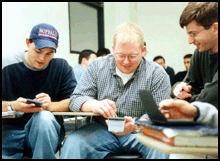
(Left to right)
Tim Martin, Jason DeVore and Mike Castellani, all seniors, with
their personal digital assistants—PDAs. |
| |
Photo:
Stephanie Hamberger
|
UB is among the first academic cluster-Carnegie Mellon, Pennsylvania
State, Princeton and Stanford universities, and the Georgia Institute
of Technology also were selected-to work cooperatively with Palm. For
the research, Palm has provided each student in the class with one of
its personal digital assistants, or PDAs.
The collective class project at UB entails students in the Electronic Instrumentation Design class developing "a small sensor module that will interface to the Palm (hand-held) using an infrared link," said John K. Schneider, adjunct professor in the Department of Electrical Engineering who is co-teaching the class this semester with Darold C. Wobschall, associate professor of electrical engineering.
"These instrumentation modules that we will develop can be used to collect a variety of sensor data, and that data can be transferred to the Palm on command through a custom software program (that will utilize the infrared links) that we will write as part of this class project," he said.
The module, roughly the size of a deck of playing cards, will be able to take temperature and humidity readings, from which the Palm would capture the information and store it until it could be downloaded onto a PC. The real-life application might involve, for example, using a Palm in a factory to monitor the temperature of a motor.
The project is unique to UB.
"Every university is free to choose applications germane to their area of interest," Schneider said.
And students clearly are anxious to succeed.
"We're kind of pioneering the PDA field," said Tim Martin, a senior in the class. "Most times, you learn about old technology-this is something new."
"That's plenty of motivation to work hard at it," said senior Rudi June, who touted his research during a recent job interview. The project, it seems, is somewhat of a hot ticket into the industry.
"From an engineering point of view, (the project) gives them a knowledge base they have not yet been exposed to in our department," Schneider said of the students, who are seniors and graduate students. "From a Palm point of view, it opens up new applications for their organizers. This may open up a whole new market area for engineers and people who want to do data acquisition."
The class mix of both industry engineers and students involved in theoretical research and the thrust toward "applied versus raw research in our long-term plan" was what made UB attractive to Palm, said Schneider, who was the primary force behind getting UB on board with the company.
Brian Fitzgibbons, Palm's education business development manager, said Schneider happened to approach him about collaborating at a time when he was trying to solicit potential participants for the program.
"What he was looking to do was a good match for our program," he said.
And now that UB has claimed a highly coveted spot with Palm, Schneider is looking to pursue the venture in a greater capacity.
"We expect to show to Palm a much-larger vision of what we would like to do (and) continue to build on it every semester to work this into a much more comprehensive system for using Palm for general data acquisition," he said.
Connecting with Palm, Schneider said, is an ideal situation for everyone involved.
"It's very indicative of what is taking place between academia and industry today," he said. "Academia continues to be our sole source of theoretical research, but industry has more than ever begun to turn to academia for applied research."
Quoting IBM statistics, Fitzgibbons said that within the next five years, more than 80 percent of new corporate applications will be designed for non-PC devices, such as pagers, mobile phones and PDAs.
Schneider sees the project as mutually beneficial.
"The purpose of this course-from the class point of view-is to educate students on the latest techniques on PDAs and their use for data acquisition," he said.
The purpose of the course from Palm's point of view is to graduate engineers conversant in Palm hardware and software, Schneider said, adding that being well-versed in PDA technology can create a more marketable student.


