| VOLUME 31, NUMBER 31 | THURSDAY, May 11, 2000 |


By ELLEN
GOLDBAUM It's a hybridized
water flea, the result of an invader European species mating with the
native species, and according to Derek Taylor, assistant professor of
biological sciences, it may replace the native water flea species in Lake
Erie.
"The problem
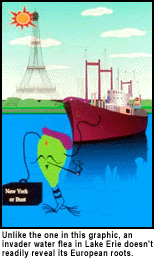
is, the European water flea doesn't have any identifying characteristics,"
Taylor explained, "so, if it got carried over by a ship from France, say,
it's not going to be wearing a beret and mustache," Taylor explained.
"It looks just like the native species."
Studying
the outcomes of animal hybridization-whether in Lake Erie or in the farthest
reaches of the Arctic-is Taylor's life work and it forms part of the basis
of the recent $478,000 Faculty Early Career Development Grant he recently
received from the National Science Foundation. The awards recognize young
faculty members who have demonstrated outstanding potential as science
and engineering investigators and educators.
"We need
to know how to make these distinctions because the hybrids can take over,"
said Taylor. "And because they are harder to detect, the hybrids can be
more insidious, so we have to use genetic markers to see their berets
and mustaches."
These markers,
which Taylor searches for in organisms that live in the waters of the
Great Lakes and Arctic ponds, help scientists determine the outcome of
hybridization.
"By combining
genetic markers with lake sediment analysis, we can reconstruct the past
in a way that wasn't possible before we had this technology," said Taylor.
Water flea
embryos that are entombed in the sediment are identified through the use
of genetic analysis and polymerase chain reaction (PCR), which amplifies
genetic information. The sediments contain in their layers hundreds of
years of live embryos of organisms that provide an important insight into
how their genes have changed over time. According to Taylor, an evolutionary
biologist, hybridization is of particular interest because it can lead
to the transfer of adaptations from one species to another or even to
the formation of a new species. Many agriculturally important species
and some infamous pests-such as the so-called killer bees-are hybrids.
The purpose
of Taylor's work in the polar regions is to find possible answers to one
of the most basic questions of human survival: Where did everything come
from?
"Every culture
has its creation myth, which is how we try to describe how the species
formed," said Taylor. He illustrates his lectures with the Arctic story
of Sedna, the Inuit goddess whose fingers, it is believed, froze in icy
waters and then fell off, each one spawning a brand new species.
Taylor,
who looks at that question from the scientific perspective, has chosen
the freshwater ponds and lakes of this part of the world-among the most
threatened habitats on the planet-to study because of its relative youth
and because it is a showcase for speciation.
This summer,
Taylor will lead an expedition of graduate students to northwestern Alaska,
a pilot for next year's course that will be geared toward undergraduates,
and which will take students to an area called Resolute, just south of
the North Pole.
Supported
by the education component of the NSF Career Award, the course will be
the only High Arctic-literally, the top of the world-course in North America
that teaches the use of molecular tools. The two-week course will expose
students to a region that that few humans have ever observed.

News Services Editor
 There's a new invader in Lake Erie, though you wouldn't know it to look
at it.
There's a new invader in Lake Erie, though you wouldn't know it to look
at it.
Front Page | Top Stories | Briefly | Q&A | The Mail | Photos
Sports | Exhibits, Jobs, Notices | Events | Current Issue | Comments?
Archives | Search | UB Home | UB News Services | UB Today