Improving infrastructure to enhance student life
By CHRISTINE VIDAL
Reporter Editor
 A mere quarter of a century ago, UB's 1,200-acre North Campus was undeveloped land. Eight million square feet and $1 billion later, an academic community thrives on a site that once was wetlands.
The university's roots go even deeper on the South Campus, which has been home to UB since the university purchased the 150-acre Buffalo Plains site in 1909. Once the university's only campus, it increasingly has taken on a health-care/professional focus as the North Campus has developed and the focus of undergraduate programs has shifted to Amherst.
Together, UB's two campuses each year provide educational opportunities to more than 23,000 students and, in doing so, have become a major economic engine for the region, pumping an estimated $1.41 billion a year into the Western New York economy.
And UB's importance to the future of the region, as well as the state, is likely to become even more pivotal as the university and the State of New York continue to make major investments in the physical plant and educational resources that constitute UB's infrastructure.
Gov. Pataki announced recently that over the next five years, the state will make a capital investment of $105 million in the North and South campuses.
UB also has made a commitment to invest $100 million over 10 years in the South Campus. This investment will focus on developing a premier health-science education and research center, improving the physical appearance of the campus and upgrading recreational and other facilities for students.
Among the projects that are under way or are in the planning stages:
- The first new housing project constructed at UB in more than 20 years, which will provide approximately 620 undergraduate students with on-campus, apartment-style housing. Currently under construction on a 10.9-acre site bounded by Audubon Parkway and Hadley and Rensch roads, the $18 million complex is expected to be ready for occupancy next fall.
- A $7 million mathematics building, to be located near the Natural Sciences Complex and the Computing Center on the west end of the North Campus academic spine. It will house the only arts and sciences department still located on the South Campus.
- A student-services building just north of Capen Hall on the North Campus that will improve student access to critical services, such as admissions, financial aid, and career planning and placement.
- Renovation of Goodyear and Clement halls on the South Campus into apartment-style student housing, as well as the construction of additional housing on the North Campus, possibly sponsored by the UB Alumni Association.
A major factor guiding investments in UB's infrastructure is the effort to make it "a student-centered institution," says Dennis R. Black, vice president for student affairs, echoing his division's motto, "Students First."
"When we talk about planning," says Black, "we build into the decision-making process what students need, what students want and how best to listen to those voices and meet those needs."
For instance, student-services offices "all need to be in a core area," he says, referring to the need for a new student-services building, "so the answer to a problem isn't, 'You're on the wrong campus' or 'You're on the wrong side of campus.' At most, the answer is 'You have to go across the street.'"
While UB's investment in its physical plant includes significant construction projects, some of the changes that are occurring are more subtle, but also vitally important.
Like maintenance of existing buildings.
"UB struggles like all universities with taking capital resources and managing them in a way that balances program needs, such as new space, with the real infrastructure - buildings, roofs, air-conditioning systems, electrical systems," says Senior Vice President Robert J. Wagner.
Infrastructure support vital
Putting off necessary maintenance, he says, can be very costly. This summer alone, the university spent more than $4 million on both campuses to reconstruct sidewalks, roadways and parking lots; repair roofing, and rebuild entryways.
"The university has so many program needs that often people would like to trade off infrastructure support, which in the long run turns out to be a strategy that costs more and doesn't provide the buildings and services people want," Wagner notes.
"We've spent enormous energy putting in buildings. It's time to be saying 'We need to do a better job maintaining them.'"
Investments in UB's buildings and grounds, he adds, are important to student, faculty and staff morale.
They also are an important part of student recruitment, since buildings and grounds are seen as a reflection of UB's quality, he says.
"What the capital plant looks like, how it is maintained, is important," he says, noting that for the first time, UB's budget this year includes funds to improve appearance and aesthetics.
Those improvements include a $2.5 million signage program that over the next 18 months will dramatically change the way those unfamiliar with UB's layout navigate the campuses.
In addition to improved building identification, a key part of the program will be locater maps that will divide the campuses into color-coded sections. This will add to the quality of campus life, Black says.
"They will say, 'You are here, and wherever else you want to be, you can get there from here,'" he says.
The university's sensibilities are "at a transformative point," according to Black, and much of the shift can be attributed to students' changing needs.
For example, the type of housing that students want has changed from traditional, dormitory-style living arrangements to a preference for apartment-style housing.
Flickinger Court, UB's new apartment-style housing complex for 400 graduate students on Chestnut Ridge Road adjacent to the North Campus, is fully rented and has a waiting list. Construction of a similar, on-campus complex for 620 undergraduate students was begun over the summer and is expected to be ready for occupancy next fall. Additional on-campus apartment-style housing is planned for the North Campus, with construction beginning possibly as early as 1999. And long-range plans also include renovation of some South Campus dormitories into apartment-style housing.
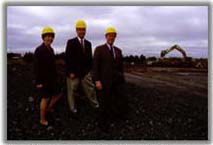 |
Looking over the North Campus site of new apartment-style housing for undergraduate students, from left, are Sen. Mary Lou Rath, Dennis Black, vice president for student affairs, and Assemblyman Paul Tokasz. Rath and Tokasz co-sponsored the legislation allowing the construction of the student housing. The housing units will be built south of the Rensch entrance and east of Hadley Road. |
Student dining preferences also have changed, Black points out.
Goodyear Hall's new "Main Street Market" has replaced the familiar cafeteria lines with stations where food is prepared to order when students make their selections. The marche-style dining approach is being considered for the North Campus as well.
Another investment to improve student life is the upgrade of UB's athletics program and the move this year to the Mid-American Conference. In conjunction with the move of UB's football program to Division I-A next fall, UB Stadium is being expanded by 14,500 seats in a project slated to start next spring and to be completed before the home kickoff of the 1999 season.
Adding seats to the stadium is about more than expansion of UB's athletic programs; it's also about campus traditions, says Black.
"We're attempting to use athletics to jump-start student life and to invite the community to participate. We know how athletics contributes at other institutions. We don't have that history or tradition here," he says. "What athletics can bring to campus life and student spirit was demonstrated at this fall's first football game. That needs to become the norm."
Upgrade in academic area
Another upgrade that will occur next fall - this one in the academic arena - will be the requirement that all freshman entering UB have access to a computer. The new computer-access requirement is part of UB's ongoing efforts to upgrade equipment and infrastructure to support teaching, research and administrative needs, as well as to become a technological leader in higher education. UB administrators say that universities that have instituted similar measures have experienced increases in admission applications and acceptances, as well as improved student retention.
UB is "trying to address students needs in new and creative ways," Black notes. "We want to make the university attractive to students and to retain them so they get from us what they came for."
The computer-access requirement will change instructional dynamics, as classroom learning is enhanced by technology. It places a responsibility on faculty members to use technology in their instruction, and on the university to invest in new hardware and software, provide training and upgrade existing equipment and facilities.
This summer alone, more than 400 new computers equipped with the Windows NT operating system and numerous text and graphics software packages were installed in refurbished public labs, disk space for students was increased 10-fold, the number of modems was nearly doubled, open ports for laptops were installed at various site and the most robust password security system available anywhere had been installed on the university network.
More than 150 of the state-of-the-art computer workstations are located in four new public computing sites in the first floor of the Undergraduate Library, the third floor of the Science and Engineering Library and the second and third floors of Lockwood Library. The second-floor Lockwood site is an extended hours location - open until 2 a.m. during the week - while the first-floor south area in the UGL is open 24-hours a day, Mondays through Thursdays.
There is no question that the technology upgrade requires a major investment of funds, some of which will come from the five-year, $105 million capital plan.
President William R. Greiner lauds the state for its five-year investment, but says UB, as a "big economic power in Western New York," needs more than $105 million when it comes to investments in infrastructure to make its vision a reality.
In these days of shrinking state resources, it's mandatory that the university target new funding sources, Greiner adds. As a result, UB's development efforts have become increasingly important to its future fiscal health.
Coinciding with its expanded development effort, the university is in the process of "rebuilding bridges with its alumni," a resource that the university essentially stopped tapping for support in 1962 when the then private University at Buffalo became part of the State University of New York, Stein says. The results to date, he says, are encouraging.
"You need to understand that individuals are giving back to the university because the university or one of its programs has given them something," he says.
UB has 155,000 alumni who are leaders in their fields or in other ways very successful because of the education they received at UB, Stein says.
And they're grateful to the institution. Many were the first in their families to go to college. Others worked their way through college.
"They're indebted to the university...for making their dreams possible. That's very exciting," he says. And the contributions that those alumni make to UB are the funds "that allow the university to compete for and retain the very best students."
Front Page | Top Stories | Briefly | Events | Electronic Highways | Sports
Current Issue | Comments? |
Archives |
Search
UB Home |
UB News Services | UB Today

