| VOLUME 29, NUMBER 34 | THURSDAY, JUNE 18, 1998 |


Xerox CEO speaks on partnership values for Industry-University Day
By RON CHURCHILL
The second annual Industry-University Day luncheon, sponsored by the School of Engineering and Applied Sciences, drew approximately 220 business representatives from around the globe, in addition to UB faculty and administrators and about 90 engineering students who have been granted summer internships with major companies through the university's Engineering Career Institute.
In the keynote speech, titled "American Competitiveness: A Matter of Partnership," Allaire gave an optimistic outlook on the U.S. economy.
"I believe it's in good shape and gaining momentum," Allaire said, but he pointed out two major problems which he says constitute "storm clouds on the horizon."
The first, he said, is very little progress in the U.S. educational system, especially in primary and secondary education, and the second is a drop in total government spending for research and development.
"The only way we can attack these issues is by establishing vital partnerships among business, government and academia," said Allaire, who also is a member of the Council on Competitiveness, a private, nonprofit organization of chief executives from business and academia.
The goal of the Council is to focus on improving American companies and helping them compete effectively in the world economy, he said. "It's critical that we work together-business, academia and government-to solve our education issues.
"In the modern world, wealth is created by the product of high human intelligence. It's the product of brainpower, entrepreneurialism, of creativity, of innovation."
Businesses are interested in the educational system, Allaire said, because "in today's economy, education is absolutely critical to a productive life.
"People who have better educations have better jobs. People with better jobs are less likely to turn to drugs or crime. People with a better education are less likely to be unemployed or on welfare for a long time."
With regard to research and development, Allaire said we have to "develop a new paradigm... to avoid any perceived or real drop in our collective commitment to R&D.
"At a time when other nations are increasing (R&D commitment), we're decreasing, and so we really have to look at ways of preventing this, and particularly of creative ways to utilize the research and development capabilities that we have in a much more effective manner," he said.
"And particularly, (we have) to assure that we do not do damage to our research universities, where a lot of the fundamental research ideas-that are then commercialized by our corporations-do, in fact, come about. This is because R&D really is the driver of our economy.
"Innovation, which is what our new economy is based upon, comes from the intellectual capital that goes into research and development," Allaire said.
Focusing on UB, Allaire pointed out that the school of Engineering and Applied Sciences has had a long-standing partnership with industry. (Last year, UB and Xerox signed a memorandum of understanding to collaborate in areas such as research, information technology, education and training.)
"It's clearly a win-win for everybody who participates in it," Allaire said. "It's a win for the students who have participated in internships at more than 80 different companies. The faculty also win by their participation in industry-sponsored research at more than 60 companies, and I think the major win is for the companies that will tell you they've gained enormously from this association with both faculty and with the students."
"Partnership makes it go," Greiner said. The president noted the recently formed UB Business Alliance, chaired by Mark H. Karwan, dean of the School of Engineering and Applied Sciences, which was created to help facilitate partnerships.
"We hope, through the UB Business Alliance, to extend the various partnerships we have in the region. We think working together in upstate New York we can have the kind of resurgence that will blow away concerns (that) the upstate economy is dead."
"Vital Partners" was the theme of the luncheon. On hand to accept the first annual Vital Partner Award, which was established to thank a company that has displayed a comprehensive relationship with, and exemplary generosity to, the school of engineering, was Praxair Inc.'s Bill Therrien, vice president of engineering and supply systems.
Reporter Contributor
More than 350 people packed the atrium in the Center for the Arts June 2 to hear Xerox Corp. Chairman and Chief Executive Officer Paul A. Allaire speak about the necessity of partnership among business, government and academia in maintaining a healthy U.S. economy.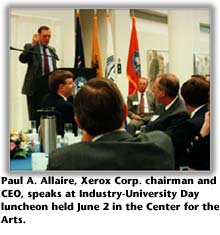 "This is the largest gathering we've ever had here in the atrium," President William R. Greiner noted, with the exception of a few major events associated with the Mainstage theater.
Current Issue | Comments? | Archives | Search
UB Home | UB News Services | UB Today