| VOLUME 29, NUMBER 31 | THURSDAY, MAY 7, 1998 |


Theming of America: Is what you see what you get?
By BRENT CUNNINGHAM
Almost every "Hard Rock Cafe" has heavy brass doors, gold records hanging on the walls and an automobile crashing through the roof. But what product are they selling?
In the case of the Hard Rock Cafe, rock music becomes a connotative "sign" for diner food. According to Gottdiener, while anything that stands for something else can be considered a sign, what marks contemporary society is the increasing value placed on the sign itself, rather than on what it stands for. Thus, adults and kids alike go to Disneyland less because it offers amusement park rides and amusement park food, but because the space called Disneyland functions as a sign for the wider world of Disney-its cartoons and movies, its "family" orientation, its sense of a "magical" escape.
Using Aristotle's division between objects that have use-value, such as food, and objects that have exchange-value, such as currency, Gottdiener suggested we ought to add "sign-value" as a third category.
"Experiences now have value," he said, "because they are signs. Again, there are these fluid boundaries: it's possible for something to be valued as a sign but also have use-value, and it's certainly possible for something to be valued as a sign but to also have exchange-value. In fact, the economy exploits that exchange-value of signs. Nevertheless, there's an independent dimension that we can speak about."
The most obvious marker of this independent dimension is, for Gottdiener, simply the difference in price between a standard product-food in a diner, the price of an amusement park ride or a functional car-and an object purchased for sign-value-food at the Hard Rock Cafe, a ride at Disneyland or a car bought for the sake of status.
Applying these concepts to a discussion of the upcoming "twinning" of the Peace Bridge, Gottdiener suggested that current debate about the project seems to be about the bridge's visual appearance, and hence its sign-value.
"The issue for me," he said, "is what about use-value? And what about exchange-value? The focus has been on the spectacular nature of the bridge itself as a theme, as a signature statement."
Earlier, Gottdiener had drawn attention to the disappointment that often accompanies a purchase made solely for sign-value, but he did not explicitly connect this idea to the Peace Bridge.
A good example of this disappointment, he said, "would be with a CD. My children take one home and it's not anything like the MTV video they saw, or this world that was promised to them, which they expected to be transported to as a consequence of making that consumer purchase. But we're tricked in a lot of ways as well."
Even so, for Gottdiener there is nothing inherently deceptive or disappointing about "theming" a business or about exploiting sign-value. Showing slides of the Landmark Bar in the Buffalo airport, which takes Frank Lloyd Wright's Buffalo houses as its theme, Gottdiener pointed out that its sign-value, unlike that of the Hard Rock Cafe, at least retains a denotative relation to its location, if not to its food. The same is true of Iridium, a music-oriented restaurant across the street from New York City's Lincoln Center, he noted.
But at the other end of Gott-diener's spectrum stands Las Vegas.
"This is the operation of sign-value at its most spectacular," he said, showing slides of an casino built to look like an pirate's island, a casino the size and shape of an Egyptian pyramid and a casino that at first appears to be seven or eight separate skyscrapers pressed together, forming an enormous replica of the New York City skyline.
Here, said Gottdiener, the sign seems to have no denotative connection whatsoever to the product or the location.
"This is a casino," he emphasized as he showed a slide of the gold and marble sculptures in Caesar's Palace. "Think: 'bingo hall.'"
Reporter Staff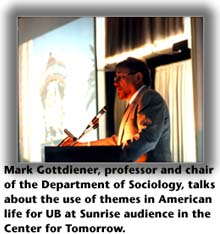 "What we're talking about, ladies and gentlemen, is diner food," noted Mark Gottdiener, professor and chair of the Department of Sociology. Speaking April 28 at the UB at Sunrise breakfast series in the Center for Tomorrow, Gottdiener used the Hard Rock Cafe as an example of what he calls the "Theming of America": the recent social trend toward emphasizing and exploiting connotations-the wider associations that are triggered by a "theme" like rock music-over more direct references, or "denotations," which would relate to what someone actually sells or does.
Current Issue | Comments? | Archives | Search
UB Home | UB News Services | UB Today