| VOLUME 29, NUMBER 28 | THURSDAY, APRIL 16, 1998 |


Hyperreal could enrich customer's experience, Sternberg says; Culture lessons in themed environments
By PATRICIA DONOVAN
Maybe so, says Ernest Sternberg, associate professor of planning in the School of Architecture and Planning, but hyperreal consumer environments can do more for our collective intellect than sell us Italian sausage and a moment on the Po.
Writing in a recent issue of the interdisciplinary journal Inquiry, Sternberg says that the themed environments often decried by intellectuals have the potential to awaken our understanding of just how we make sense of our world.
Symbols could be explained
If we want them to, he adds, these environments could demonstrate which cultural signs and symbols push our emotional buttons and how entrepreneurs use this information to sell products.
The producers could, for instance, demonstrate within the environment itself how they successfully identified those items familiar to us (cowboy hats, checked tablecloths, bunkhouse-style walls, the smell of charred meat, for instance) and then attached meaning to them (nostalgia, the Old West, 1950s "B" movies, cozy folks, adventurous community, voracious frontier appetites) to draw us to a site of shared meaning where we can spend a lot of money.
A themed environment that would let us detect its manipulative devices, says Sternberg, would add depth and meaning not only to the (commercial) experience, but to our understanding of how culture, memory, imagination and need provoke our behavior.
Such possibilities could be developed in a number of ways, he writes. Designers could elect to reveal to the consumer the interaction between themselves and the environment as they dance the night away-the calculated thematization, the relationship of food to gluttony, and above all, how a commercial establishment performs the expressive work of demonstrating to us just what moves us, what calms us, what turns us on.
Awareness for consumers
Consumers would be invited to become aware of what drew them to that place; what images were used to evoke a response in them, and how, and what music, decor, color, smells, costumes, service behavior and activities were employed in order to engage them in a shared fantasy. Hyperreal environments have long drawn the scholarly attention of epistemologists-philosophers who study meaning and knowledge. Some have expressed more than a little concern that these commercial enterprises deliberately confuse illusion with reality, causing the public to lose its sense of what has authentic value.
Sternberg says that as a result, themed environments from Disneyland to exotic-but-safe adventure vacations, "tend to epitomize contemporary tendencies that intellectuals commonly deplore."
He writes that while such places may be exceedingly low-brow to some, it is possible for them to "awaken the viewer's critical faculties by prompting a self-awareness of the very denotational and expressive strategies" used by the producer to imbue the product with meaning.
Drawing on the writings of such notable semioticians as Jean Baudrillard and Daniel J. Boorstin, Sternberg explores their stalwart insistence that we must defend the everyday distinction between reality and illusion in order to battle the increasing dominance of image and artifice in our lives.
Sternberg points out, however, that the claim that technology-driven capitalism has engrossed us in artificiality need not cause us to pine for the reality that has forgone. Nor do we need to lament what some see as the collapse of the distinctions between reality and image. It is not the case, according to him, that when we tear down this reliable barrier "we fall into the worlds of illusion, simulation and simulacra."
Awakening critical faculties
Sternberg agrees with Nelson Goodman's theory of referentiality, which identifies even deliberately illusory commercial productions as "authentic" if the thing symbolized and the way it is symbolized is detectable and detected. Such a production would awaken the viewer's critical faculties. Sternberg says there is no reason why producers of hyperreal environments couldn't deliberately provoke such scrutiny in order to enrich the customer's experience.
So someday Planet Hollywood may become highly epistemological. It may urge its customers to recognize its suggestion that the quarter-pound Brad Pittburger with a little Uma Thurman on the side allows us to literally make youth, beauty, blondness, vigor and fame one with our own furry flesh and cholesterol-laden blood. We are fantasy-cannibals
News Services Editor
A proliferation of "pretend" environments, from cowboy-themed fast-food joints and movie-star nightclubs to small towns done up in the garb of 19th-century Bavarian villages, are attempting to attract consumers through the use of the carefully constructed artifice.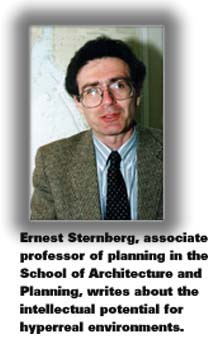 Some complain that the rush to replicate other realities is just one more cheesy attempt to excite jaded consumers.
Current Issue | Comments? | Archives | Search
UB Home | UB News Services | UB Today