| VOLUME 29, NUMBER 23 | THURSDAY, MARCH 5, 1998 |


Celebrating Women's history; Archives plans exhibit, symposium on fight for women's rights
By PATRICIA DONOVAN
Both will explore the roles of local women's organizations in promoting and supporting radical changes in the personal, social and political status of women.
"Since Seneca Falls: Documenting the Experience of Women on the Niagara Frontier," an exhibition of original materials on the experiences of Western New York women's organizations from the turn of the century, will open March 18 in the Archives' Poetry and Rare Books Room, 420 Capen Hall on the North Campus. It will continue indefinitely.
The symposium, "Understanding Women's History: Interpreting Primary Sources and Exploring New Methods for the Study of Women's History," will explore new methods of interpreting primary sources, such as diaries, letters and civic records, in the study of women's history. It will take place from 3-5 p.m. March 27 in the Archives, 420 Capen Hall. A public reception will follow from 5-7 p.m.
The symposium will be free and open to the public. Attendance will be limited. To make reservations, call 645-2916.
The symposium will consist of two panel discussions on such topics as using organizational records to study women's literature, an oral history of foreign women academics at UB, the politics of collecting women's records, and Internet resources for women's history. Guests will include representatives from Buffalo-area women's groups that have donated their records to the UB Archives.
Christopher Densmore, acting director of the archives, and Kathleen Delaney, a graduate student in the School of Information and Library Studies, will curate the exhibit, which will include materials from the archives' Women's History Collection.
Through scrapbooks, photographs, diaries, organizational minutes, publications, news clips and memorabilia, the exhibit will illustrate the social, educational and political functions of local women's organizations, including Zonta International, founded in Buffalo in 1919; the National Organization for Women; the League of Women Voters; Business and Professional Women of Western New York; Pen Women, and Campfire. The exhibit will demonstrate how the groups and individuals associated with them worked to promote equal rights in law, to acquire suffrage for women and to develop opportunities for educational, business and political accomplishment for women, despite deeply rooted opposition.
It wasn't until many years after the Seneca Falls Convention that women's-rights advocates succeeded in attaining passage of the Married Women's Property Act, worker protection laws and the 19th amendment to the U.S. constitution, which provided the vote for women.
They fought to secure military status for nurses in the armed forces, changes in family-planning programs and abortion policy, Title IX of the Education Act, for inclusion of women as a protected class in the Civil Rights Act of 1963, the Equal Pay Act of 1964 and, since 1923, for an Equal Rights Amendment to the Constitution.
The Seneca Falls Convention inaugurated the public demand by women for changes in restrictive gender-based laws and practices in the United States. Densmore said the convention's resolutions, many of which have been established in law over the past 150 years, were referred to in 1848 by the Seneca County Courier as "of the kind called radical." The paper warned that "some will regard them with respect-others with disapprobation and contempt." Such has been the case.
News Services Editor
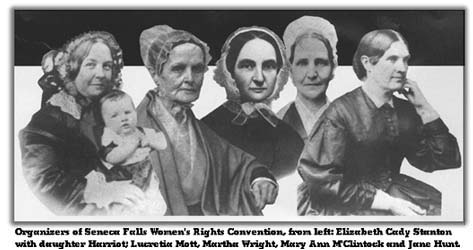
The UB Archives this month is celebrating Women's History Month, as well as the 150th anniversary of the Seneca Falls Women's Rights Convention and its Declaration of the Rights of Women, with an exhibit opening on March 18 and a symposium scheduled for March 27.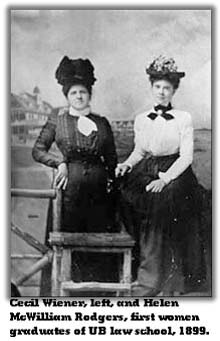 The exhibit also will feature documents and artifacts that speak to the role of women at UB over the past 152 years, including the admission of women to medical and law schools, the "co-ed invasion" of the 1920s, the development of UB's Women's Studies Program, conditions for women at UB and the discussion of implementation of recommendations of the President's Task Force on Women.
Current Issue | Obituary | Comments? | Archives | Search
UB Home | UB News Services | UB Today