| VOLUME 29, NUMBER 21 | THURSDAY, FEBUARY 19, 1998 |


Antibiotics vs. infectious bacteria: a battlefield report
By BRENT CUNNINGHAM
If there is the possibility of infection, drown it in antibiotics.
This, according to Charles Ballow, is the kind of "common sense" that may ultimately make antibiotics useless against certain types of infectious bacteria, a development that he said would be "apocalyptic."
Ballow supported his contentions with a series of statistics. Staphylococcus, a highly virulent and potentially fatal bacterium, became resistant in 1975 to all antibiotics except Vancomycin, and there is growing concern, said Ballow, that it soon may develop this last resistance. Likewise, in 1990, the common infectious bacterium called pneumococci was 96 percent susceptible to antibiotics. Today, it is only 60 percent susceptible.
Antibiotics, said Ballow, have become "an industry potentially consuming itself" because every time we use antibiotics, we create the potential conditions for susceptible bacteria to mutate into resistive bacteria.
Bacteria, Ballow explained, are subject to spontaneous mutation and genetic mutation. Like all evolving creatures, they can develop resistant traits and pass those traits throughout the species. Moreover, bacteria are capable of fusing with other species of bacteria and sharing the resistant trait, a process known as "plasmid resistance."
"This is a conspiracy," Ballow, only half-jokingly, pointed out.
He argued that the first step in winning battles against infectious disease is to control and decrease the use of antibiotics, which should be used prudently, specifically and for a shorter duration, he said. He recommended developing clinical-practice guidelines for the prescription of antibiotics and reviewing the use of antimicrobials in animals.
In 1985, according to Ballow, cattle, swine and poultry industries in the United States used 18 million pounds of antibiotics and today, he said, the figure is probably much higher. In 1992, there were 40,000 to 50,000 pounds of antibiotics sprayed on U.S. fruit trees.
"It's quite clear," said Ballow, "that these organisms then show up in our food chain...and set us up for infection by resistant organisms."
Ballow suggested that it might be possible to decrease these numbers, though he pointed out that it would probably require "more than an act of Congress" to convince the cattle, swine, poultry or agriculture industries to change their practices.
Ballow's other recommendations included a critique of the current disease-surveillance system in the U.S. He pointed out that the Centers for Disease Control and Prevention, which would be the logical place to reform current antibiotic practices, do not have the authority to require information from health centers or industry.
"How does this system work?" asked Ballow. "The answer is, 'not very well.'"
Ballow's definition of the "prudent" selection of an antibiotic includes such considerations as whether antibiotic therapy is necessary, whether oral therapy can replace IV therapy, whether a narrow-spectrum drug can be used over a broad-spectrum drug and whether a different antibiotic would have a lower potential for resistance.
Is there hope that medical technology can save the day without all these new regulations and practices? Researchers are constantly looking for new antimicrobials, said Ballow, and new ones are slated to be approved for use, but these amount to only a relative handful.
"If we use them too much, we're going to lose them," he noted. "They should not be first-line therapy."
Ballow did find a glimmer of hope in his own experiences at Millard Fillmore. Recently, when there was an outbreak of resistant bacteria, the hospital was able to reverse the process by taking the offending antibiotic out of the environment. The bacteria again became susceptible.
Although the majority of bacterial infections remain treatable, Ballow remains skeptical about the future. "Human nature being what it is," he said, "I don't see us acting proactively. But public-health awareness can go a long way."
Reporter Staff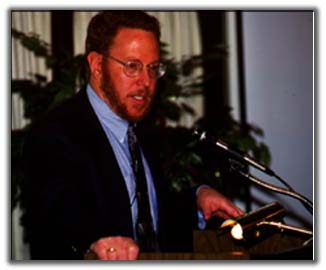 Speaking Feb. 10 in the Center for Tomorrow as part of the UB at Sunrise series, Ballow described the history and current status of the "war against infectious bacteria." A clinical associate professor of pharmacy and director of anti-infectives research at Millard Fillmore Hospitals, Ballow charted the triumph of penicillin and its offshoots in the 1940s, the growing awareness in the 1970s and 1980s that antibiotic technology might have limits and the explosive growth of antibiotic-resistant infectious bacteria in the 1990s.
Current Issue | Comments? | Archives | Search
UB Home | UB News Services | UB Today