| VOLUME 29, NUMBER 18 | THURSDAY, JANUARY 29, 1998 |


Faculty Staff Q&A
Purchasing is a rather broad term. What does the Purchasing Office do?
In one year, State Purchasing processes approximately 30,000 requisitions, and buys $55 million in goods and services. Our goal is to do this in a timely, efficient and cost-effective manner, to follow the many state rules and regulations and to give the best customer service possible while doing so. We deal with every department connected with the university and make all attempts to obtain what our customers want, while being good stewards of taxpayers' money.
What do you consider the most challenging aspect of your job?
The challenges that we face are the part that makes our job interesting , and sometimes exciting. Meeting the deadlines of our customers while complying with the rules (you want it when!), end-of-budget-year craziness-customer needs it right away, but has no money, or customer has this amount of money to spend in this fiscal year and needs to spend it fast! Our greatest challenge this year is the merging of the State and Research Purchasing and Payables departments. The "one-business-office concept" is being applied to better meet our customer needs. This is a major change in the service relationships, but one that we think in the long run will be better.
What's the greatest change in purchasing regulations since you've been at UB?
The university system now has more independence in processing orders than ever before. It used to be that all orders over $20,000 had to go to Albany, the Office of the State Comptroller, for approval. Now it is $50,000. The use of system contracts-i.e., Staples System contract for office supplies-changes and improves the way we serve the campus. Also, the use of the American Express procurement card will revolutionize the way we purchase supplies under $500 (74 percent of all requisitions received).
What's the most important thing people at the university should remember when they have a purchasing request?
The best thing to remember when departments have requirements is to plan for large requests well enough in advance to allow for the processing that must meet the state requirements. We want to work with you to obtain what you want, when you want it. It is also important to give as much information as possible for the item(s) that you want to purchase. Sometimes we get a requisition that gives a model number but nothing else, sometimes a description "computer" but no model number. Also, if you have obtained price quotes from different vendors, send them over with the requisition. It could save time.
What's the strangest purchasing request you've received at UB?
We purchase a great variety of "everything including the kitchen sink" items. But some of most unusual items purchased are: brains and body parts, the built-in-place Fisk organ, and the movement of very-old ice cores.
What's the most common purchasing request?
The most common purchasing request is probably for office supplies-pens, paper, etc. The most common verbal request is "How fast can I get it?
What's the most expensive item you've ever ordered?
The most expensive item was for $2.5 million for the purchase of two spectrometers that were built in England. We have contracts that exceed that amount, but that was the most expensive single purchase.
What question do you wish we had asked, and how would you have answered it?
A questions that you didn't ask is "What direction will Purchasing be going in the future?" Glad you asked! The way the university purchases will be different in the future. The influence of technology will bring a new procurement software system that will allow our customers to send their requisitions to us directly over their computers. Eventually, I foresee more ordering from the Internet. We will be setting up more primary sources of supply (one vendor supplying a specific commodity). Also, the use of American Express Procurement will have a tremendous influence on the procurement of orders under $500. The merging of the State and Research Purchasing and Payables departments will lead to the consolidation of forms (one requisition form to be used for all funding sources), one procurement card and other streamlined processes that are customer-service oriented. It is an exciting time to be in the Purchasing Department!
If you had to pick a job completely removed from what you do now, what would it be?
What would I be doing if I wasn't here? I was a teacher before I changed careers over 20 years ago. My next career might be to go back to teaching. I also have a desire to have my own business, so I am looking into that as a part-time hobby! I also love buying houses that need fixing up, doing so and then selling them. Many opportunities, so little time!
What's something people don't know about you and should?
What don't people know about me and should? Difficult question-probably that with the recent organizational change, I will be guiding the State and Research Purchasing and Payables departments, along with the Property Control Department, into the next phase of organizational change and structure
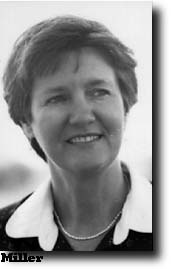 Judith Miller has been director of purchasing since she joined the university in 1988. In 1995, she received the Chancellor's Award for Excellence in Professional Service.
Current Issue | Comments? | Archives | Search
UB Home | UB News Services | UB Today