| VOLUME 29, NUMBER 14 | THURSDAY, DECEMBER 4, 1997 |


UB method may help detect land mines
By ELLEN GOLDBAUM
The research, to be published in the February 1998 issue of Physical Review E, indicates that weak shock waves sent into granular beds, like soil, will cause acoustic signals containing critical information to be reflected off buried objects, such as land mines.
In previously published work, Sen found that in model systems, shock waves travel through granular media as solitons, tight bundles of energy that travel without dispersing. That work showed that solitons, which are encountered in only a handful of known physical systems, are very stable; they travel compactly, interacting very weakly with the systems through which they travel.
Sen said the weak shock waves are soliton-like signals. "These signals are softer bundles of energy, which allowed us to strike a middle ground, generating signals that, like solitons, travel well in granular systems, but which also have some interaction with these systems.
"What our computer simulations have demonstrated is that when a weak shock wave penetrates into granular media and hits an object, the reflected pulse carries a lot of information about what it hit."
The system envisioned by Sen and his collaborators would consist of a special device that would send weak acoustic shock waves deep into soil and detect the pulses that are returned after hitting an object. The pulses would provide information about the weight and shape of the object, revealing whether it likely is a land mine.
Sen said that a key selling point for the proposed technology would be its low cost, a critical factor in developing detectors for countries where plastic land mines are common, such as Cambodia, Afghanistan and Bosnia.
He cautioned that so far, the distinguishing characteristics of the reflected pulse only have been seen in simulated systems. The next step will be to observe the phenomena experimentally by sending weak shock waves through sand or soil.
Sen's co-authors on the project are Michael J. Naughton, UB associate professor of physics and chemistry; Marian Manciu, a doctoral candidate in the Department of Physics, and James D. Wright, a master's candidate at the University of Kent in England.
The work is being funded by the U.S. Army Corps of Engineers.
News Services Editor
Plastic land mines are a guerrilla fighter's dream: they cost as little as a dollar, they're easy to make, they're often lethal and they cannot be detected by current technology.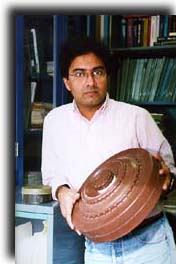 However, an accurate and inexpensive detection method effective for land mines in either plastic or metal casings may be on the horizon as the result of computer simulations conducted by Surajit Sen, assistant professor of physics.
Current Issue | Comments? | Archives | Search
UB Home | UB News Services | UB Today