| VOLUME 29, NUMBER 13 | THURSDAY, NOVEMBER 20, 1997 |


Smoking as an urban disease; M.D. works to decrease damage tobacco causes in the inner city
By BRENT CUNNINGHAM
Carlos Roberto Jaen never waves his arms, never raises his voice, but every time he speaks he conveys the passion and urgency of his work.
"The rate of smoking for the general population is about 22 percent," he said. "In the Lower West Side, we found a smoking rate of 33 percent for the women and 47 percent for the men....
Tobacco companies are profiting from the death and destruction of inner city communities.
"If smoking were something that killed people quickly," he added, "I could even see saying, 'Well, take your chances.' But the majority of these people will die in extreme and excruciating pain."
Jaen is careful to separate his criticism of smoking from a criticism of smokers. A former smoker himself, he says smoking is not a "bad habit" but rather "a chronic disease-it's not unlike diabetes or hypertension...because it's something that stays with you for a long time. I quit 20 years ago and I am still haunted by the Marlboro billboards-it's a disease that will be with me until I die...but there are very effective means of treating it."
From 1994-96, Jaen was part of a national advisory panel that assessed some of those treatments and made recommendations. Their conclusions were published as the federal "Smoking Cessation Clinical Practice Guidelines."
According to Jaen, the panel established that people who want to quit smoking "need to develop the proper skills so that they can deal with issues like cravings, social situations, negative effects and stress. And they need to develop social support, whether it be a community, your friends or your family."
Along with the need for skills and social support, said Jaen, the strongest conclusion the panel reached was that "nicotine replacement, whether it's the patch or the gum, seems to double the effects of anything we do."
He notes that this is one area where the poor have a distinct disadvantage in their struggle to quit smoking. "Very select HMOs or other health insurance may cover nicotine replacement," said Jaen, "but the majority do not-they decided not to cover any smoking-cessation treatment. This is absurd because they also cover heart attacks, lung cancer, all the experiences that come from the consequences of continuing to smoke."
But if insurance companies have acted absurdly, Jaen argues that tobacco companies have acted with nothing short of "criminal intent."
"Most of the health effects of poverty," he said, "are not related to bad habits. They are related to structural social and economic oppression, lack of opportunities to advance, lack of hope."
For Jaen, the tobacco companies are a key part of this oppressive conglomerate. "The injustice is perpetrated by a cartel that has consistently and systematically profited from the death and suffering of the American people," he said.
But, he added, to say the poor are oppressed is not the same as saying they should be pitied. "I see wealth when I look at the people on the Lower West Side....There is a tremendous sense of family," he said. "People not even related to each other are constantly caring for each other. I find that I'm privileged to be in a situation where people welcome me with open arms. I tell my wife that I'm in love with all the little old ladies who are my patients.
"We need to work hard to change the social conditions," he added. "We need to work hard to improve the ability of people to move forward. But in the meantime, I cannot sit idly by and watch these people die."
Reporter Staff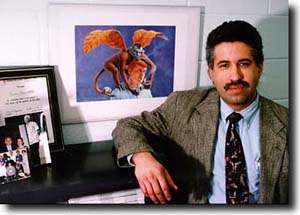 An assistant professor in the Department of Family Medicine in the School of Medicine and Biomedical Sciences, Jaen has been working to decrease the smoking rate among the urban poor ever since he received his M.D. from UB in 1989. As director of the Center for Urban Research, and as a physician to predominantly poor patients from the Lower West Side of Buffalo, he has both a statistical and an experiential understanding of the damage that smoking does to people and communities.
Current Issue | Comments? | Archives | Search
UB Home | UB News Services | UB Today