| VOLUME 29, NUMBER 3 | THURSDAY, SEPTEMBER 11, 1997 |


Faculty & Staff Q&A
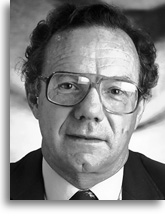
Michael F. Sheridan, professor and chair of the Department of Geology, has made a career out of natural disasters, particularly mapping the predicted flows from volcanic eruptions before they occur.
A: I developed a strong interest in volcanoes during a NASA expedition to Iceland in 1970. Hekla was erupting and we were able to climb up onto the active cone and stand on flowing lava. From that point on, I was hooked on active volcanoes. At that time, I was a professor at Arizona State University, but I had never taken a course in volcanology!
Q: Did you ever build a volcano for a school science project?
A: When I was in high school I was not aware of the earth sciences. Volcanoes were very remote to me.
Q: Tell us about your work with volcanoes.
A: My present work centers on problems of risk mitigation related to volcanoes. I concentrate on estimating the probability of volcanic phenomena affecting various areas near active or potentially active volcanoes. It ranges from forecasting events that could occur within a few weeks, as at some volcanoes in Mexico, to long-term forecasts of 10,000 to 1,000,000 years, as at the proposed high-level nuclear waste disposal site at Yucca Mountain, Nevada.
Q: Will mankind ever tame volcanoes?
A: Volcanoes can be understood, but not tamed. Maybe we will learn to respect them.
Q: What lies ahead for Mont- serrat? Should it be evacuated? Resettled?
A: Montserrat has exhibited a pattern of increasing intensity of eruptions with time. If this continues, the whole island will be at risk. At the present, about two-thirds of the original population have been evacuated. Decisions concerning the rest are best made by the civil authorities on the island.
Q: How close would you live to a volcano?
A: I love volcanoes. Therefore, I would live on most volcanoes, provided that there was a good escape route!
Q: We seem to be in a time of increased volcano activity. What's the danger to civilization?
A: A few volcanic eruptions have affected the course of civilization. The eruption of Santorini (Thera) at about 1550 B.C. destroyed the Minoan civilization and may have been a prominent factor in the Exodus from Egypt. Popocatepetl (near Mexico City) probably brought to an end the main civilization in Mesoamerica about 800 years ago and could cause as much destruction at any moment. It is unlikely that a single eruption could cause a serious global disaster, although major changes in the climate could be generated.
Q: What's a volcanologist doing at a university thousands of miles from the nearest volcano?
A: Most volcanologists go to volcanoes, rather than sit on them. What is important is to have a good research group and the facilities to analyze the data.
Q: How likely is it that a volcano will pop up in downtown Los Angeles?
A: The probability of that happening next year is less than one in 10 billion. It is much more likely that L.A. will be destroyed by a meteorite.
Q: What's it like to stand on the rim of a volcano?
A: For me it is awe-inspiring to see at such close range the great force and beauty of nature. I have witnessed both the gentle flow of lava and the terrible effects of giant explosions. My wonder and excitement never cease.
Q: What has been your most dangerous encounter with a volcano?
A: On La Soufriere Volcano, Guad-eloupe, I crossed over the active dome two days before a small explosion. The gas and steam were terrible. The eruption filled a valley that I had followed with about 50 feet of boiling hot mud and rock
Q: Did you see "Dante's Peak" or "Volcano?"
A: I saw "Volcano" and would like to see "Dante's Peak" (which is a more realistic movie).
Q: What's the most potentially active volcano near a metropolitan area in the U.S. and when is it likely to become active?
A: Most volcanologists feel that Mount Rainier is the most dangerous volcano in the USA at the present. Of course, other Cascade volcanoes could erupt before Rainier. Mount Rainier could threaten Tacoma and Seattle with giant mudflows, as it has in the past. Some volcanologists believe that it could become active within the next few decades.
Q: Tell us about your birds.
A: I breed parrots and currently have about 16 (6 pairs and the rest singles). They range from Macaws to Indian Ringneck parakeets.
Q: We hear you have llamas that you take on treks to the Adirondacks.
A: Llamas are wonderful animals. I also breed llamas for show and for backpacking. Last month, we took six llamas along the Raquette River in the Adirondacks. They carried our gear and food for five days. I highly recommend it.
Q: What question do you wish we had asked and how would you have answered it?
A: What was your most difficult expedition? That was a one-month campaign on Sheveluch Volcano in Kamchatka. We relied on melting snow for our water and were completely isolated in a remote and foreboding place. The volcano had blown its top the year before and loose ash formed small mudflows every afternoon. Much of the area between the camp and the summit was devastated as a result of a giant eruption in 1964.
Q: Tell us something that people don't know about you.
A: I enjoy working with my hands and have just built a Japanese tea house that is a close replica to the real thing.
Q: When did you first become interested in volcanoes?
Current Issue | Comments? | Archives | Search
UB Home | UB News Services | UB Today